


Surname: Eshba
Subethnos: Guma
Domain: Eshyra
Haplogroup: R1a → Y52 → Y271425
History
The tested individual is a representative of the Abkhazian noble (aamsta) family Eshba. The family is listed among the princely and noble lineages of Abkhazia, particularly associated with regions such as Guma. The Eshba family is primarily linked to the Samurzakano (Samyrsakan) district, where, in the 19th century, they owned lands and had dependent peasants. The main settlements associated with the family include the village of Bedia (Agubedia, Eshkyt) in the modern Tkvarcheli District of Abkhazia. The Eshba family’s estates were predominantly located in Samurzakano, specifically in the Eshkyt settlement (Yeshk’yt) within Bedia. However, the family also had Abzhywa, Guma, and Bzyb branches. In the second half of the 19th century, the Eshba family was most numerous in Samurzakano, where over ten households of the family resided.
According to archival records from the 1860s (reports of the Estate-Land Commission), the Eshba family were the dominant nobles in the Eshkyt settlement (Bedia). Their serfs (akhuwy) would surrender all their property to gain freedom and join the ranks of free community members (ankhawy). Daughters of serfs worked as servants in the Eshba estates, and upon marriage, the groom paid a bride price (achmu) of 10 silver rubles.
In a report from 1868 by A.V. Pakhomov, the manager of the estates of Prince Giorgi Dmitrievich (Seitbeevich) Chachba, it is noted: “The exact origin of the Eshba nobles is unknown to me, but I have heard they came from Karachay to Samurzakano.” This suggests a possible migration from Karachay (the territory of the modern Karachay people, a Turkic ethnic group of the Caucasus), though this is an unverified rumor. If this migration did occur, it likely took place in ancient times, possibly before the arrival of Kuapa Chachba and his retinue, as by the late 18th century, the Eshba family had become numerous and divided into multiple branches.
The Abzhywa branch resided in the Eshkyt settlement of the village of Gup (Gyp), where nobles such as Gyd Eshba, Gyarg Eshba, Dzhamlat Eshba, and Tamshyga Eshba lived. The Bzyb branch suffered significantly from the 1866 Muhajirism (forced migration), yet individuals like Sakyt Eshba, Hasan Eshba, Msoust Eshba, and Rashyt Eshba remained in the area. The Guma branch lived in the village of Bagmaran, where, in the second half of the 19th century, brothers Dyga and Bilal Eshba resided. Pakhomov described them as “impoverished orphans,” prompting Prince Seidbey Chachba to order assistance for them. Earlier, some members of the family established new branches in the villages of Eshera, Gup, Bagmaran, and Jirkhua.
Test results indicate a shared origin with the Abazin nobles Iashba (Eshba) and the Eshba nobles from the village of Bedia Du. Before the Muhajirism, a peasant family named Yashba-Eshba existed in Tsabal. This family included Nef sher Bashkhanum-efendi, the wife of Ottoman Sultan Abdulmejid I, whose parents were Msoust Eshba and Tulu Zvanba.
The Eshba family is considered a minor noble lineage, not among the most prominent princely dynasties of Abkhazia (such as Chachba or Marshan) but with local influence. In the 19th century, the Eshba were noted as poor and relatively uninfluential, often with only one “hearth” (household). Assimilated forms of the surname are also found in the Megrelian community (Eshbaya).
The tested individual is a descendant of Tsana Eshba.
Notable Representatives of the Family
The Eshba family produced several prominent figures in Abkhazian history, culture, and politics. Key individuals include:
Efrem Alekseevich Eshba (1893–1939): One of the most renowned members. Born on March 7 (19), 1893, in the village of Bedia (Agubedia, Eshkyt settlement) to the nobleman Aleksey Zurabovich Eshba, he was the youngest of five children. He graduated with honors from the Sukhum Mountain School (1906) and studied at the Kutaisi and Tiflis gymnasiums, later attending the Law Faculty of Moscow University (1913–1916, did not graduate).
A true son of Abkhazia and a revolutionary with an indomitable spirit, Efrem became a beacon in the struggle for Abkhazia’s independence and statehood. As a key architect of Soviet power in the region, he championed Abkhazia’s autonomy, rejecting its subordination to Georgia, and inspired the people toward self-determination. His life was a testament to his ideals, and amidst the whirlwind of repressions, he emerged as a celebrated fighter for Abkhazian identity. His name is immortalized in the streets and parks of Sukhum.
Repressions: Arrested on April 11, 1936, in Moscow on charges of espionage and counter-revolution. Sentenced by the Military Collegium of the USSR Supreme Court on April 15, 1939, and executed on April 16, 1939, at the Kommunarka firing range (Moscow). Rehabilitated in 1956.
Legacy: A street and park in Sukhum are named after him, and a monument was erected in his honor (sculptor: his daughter, Marina Eshba, 1982).
Marina Efremovna Eshba (1924–2011): Daughter of Efrem Eshba. Born in London to Efrem and Maria Vladimirovna Shigrovskaya (daughter of a Russian revolutionary), Marina embodied the strength of Abkhazian women through her work in bronze and marble, becoming the first female sculptor of her people. Nicknamed the “iron lady” of Abkhazian art, she brought to life monuments of heroes and cultural figures, preserving the memory of their deeds and traditions. As head of the Abkhazian Artists’ Union, she fought for the autonomy of creators, turning art into a bridge between past and future, and forever etching her name into the golden annals of national culture.
Foma Khukhutovich Eshba (1856–1928): An educator with a poet’s soul, he ignited the flame of knowledge in Abkhazian hearts by founding schools and creating the first textbooks in the native language. Foma became a guardian of cultural heritage, reviving the Abkhazian language and traditions during an era of oblivion. His works were like seeds from which national consciousness grew, inspiring Abkhazians to preserve their unique identity.
Vyacheslav Akhmetovich Eshba (1949–2023): A hero of modern Abkhazia, whose bravery during the Patriotic War of 1992–1993 became a shield for his homeland. As a commander of an aviation unit and later the head of the Air Forces, he defended the skies and the freedom of his people, embodying an unyielding spirit. Vyacheslav remains in memory as a symbol of courage and devotion, whose deeds strengthened Abkhazia’s independence and inspire new generations to remain loyal to their homeland.
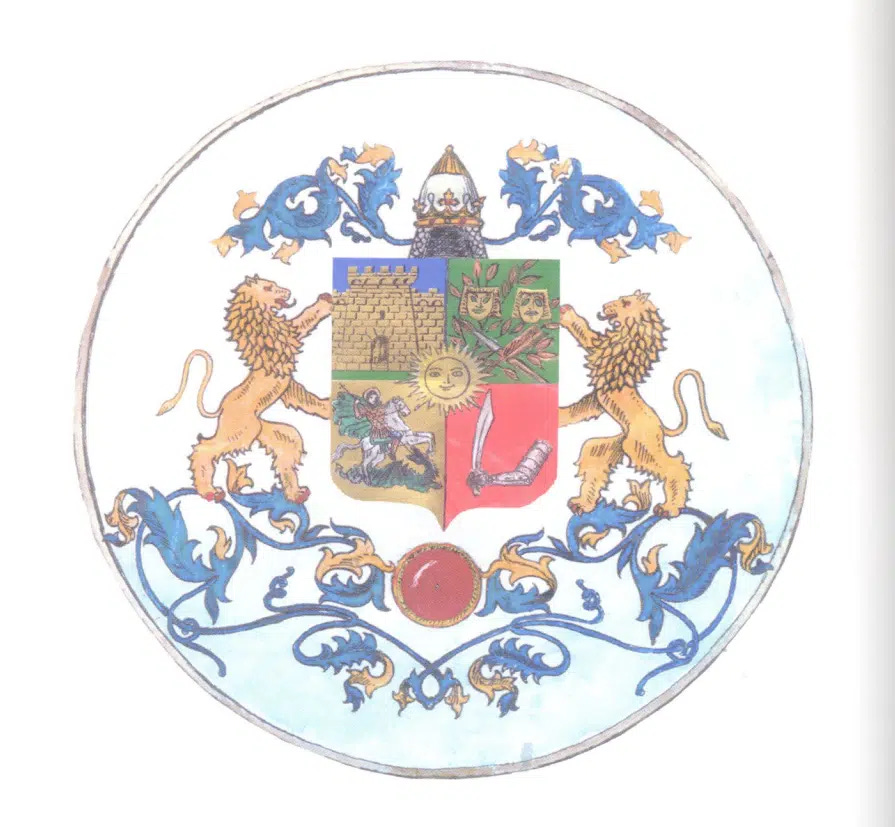
Coat of Arms of the Eshba clan:
Tamga of the Eshba clan:

Haplogroup and Subclade
A full BigY test was conducted at the FTDNA laboratory.
The identified haplogroup is R1a, with the subclade: Y52 → Y271425.
Full lineage: Adam > A0-T > A1 > A1b > BT > CT > CF > F > GHIJK > HIJK > IJK > K > K2 > K2b > P > P-V1651 > P-M1254 > P-P337 > P-P284 > P-P226 > R > R-Y482 > R1 > R1a > R-M459 > R-M735 > R-M198 > R-M417 > R-Z645 > R-Z93 > R-Z94 > R-Z2124 > R-Z2122 > R-Y57 > R-FGC4547 > R-Y52 > R-Y2631 > R-Y271425.
The R-Y2631 branch is associated with the Scytho-Sarmatian populations. This branch has been identified in early Sarmatians of the Caspian steppe (sample DA134, ~800–200 BCE) and in Western Scythians of the Middle Don region—Devitsa V, Kolbino I, Ternovoe I (3rd–2nd centuries BCE). Later, the branch appears among Sarmatians and Avars in Hungary (MDH-265, ARKper14), indicating the continuity of steppe nomadic populations from the Don River to the Carpathians. Today, descendants of Y2631 are found among Abkhazians, Abazins, Karachays, Balkars, and Adyghe, preserving traces of the ancient Scytho-Sarmatian heritage in the North Caucasus.
The Eshba test result has been published on global Y-chromosome trees (YFull, FTDNA, TheYtree).
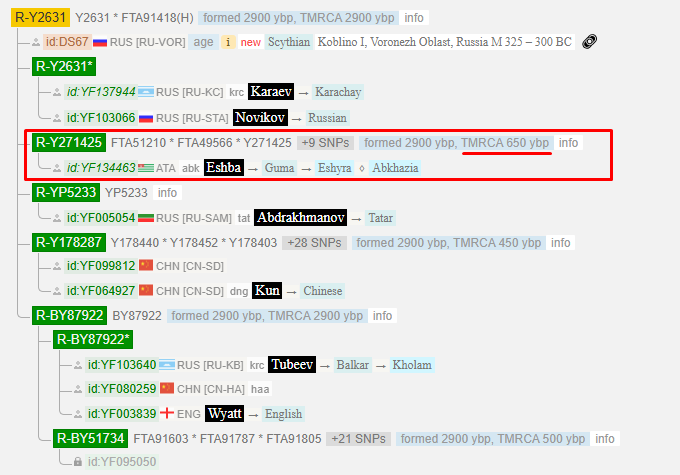
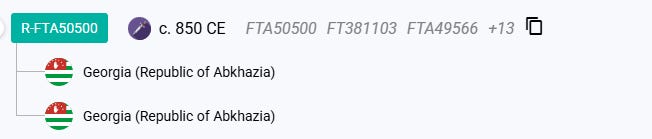
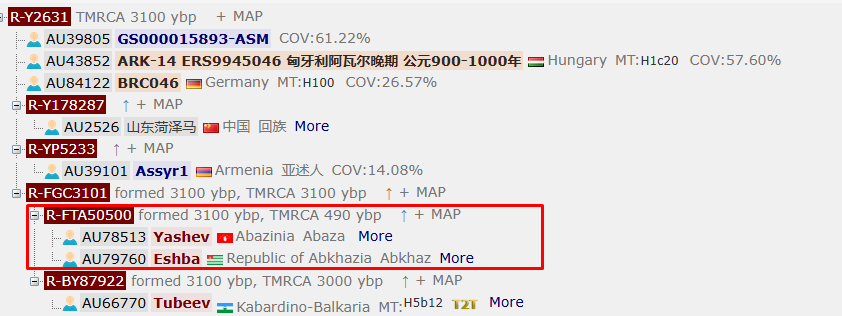
According to the YFull tree, the common ancestor of the Abkhazian Eshba and the Abazin Yashev lived approximately 650 years ago, thereby confirming the shared origin of these two families.